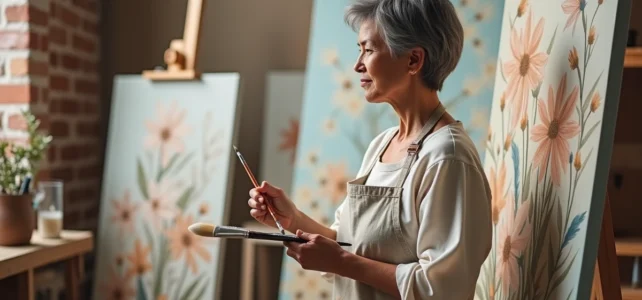
When a former model starts painting, the question immediately arises: is it merely an extension of a career in the image, or a true artistic endeavor? In the case of Béatrice Vonderweidt, the answer is evident on the canvas. Her journey, from Parisian fashion to painting exhibited as far as Tel Aviv, outlines a trajectory where the gaze upon the body and light has never really changed in nature but has found a new medium.
From modeling to painting: what the body learned in front of the lens changes on the canvas
Posing in front of a photographer for years fosters a keen awareness of framing, of soft light, and of the tension between stillness and movement. These skills do not disappear when one moves to the other side of the easel. They migrate.
In Béatrice Vonderweidt’s work, this migration manifests as a particular treatment of silhouettes in her paintings. The pose is never accidental in her compositions. We find tight framing, chiaroscuro effects reminiscent of studio photography, and an attention to body posture that only someone accustomed to being photographed can convey with such accuracy.
This link between modeling experience and painting practice is rarely analyzed in articles dedicated to her. Most merely mention the fashion-to-painting transition without exploring how one nourishes the other. By observing the photos and paintings of Béatrice Vonderweidt, one perceives this continuity: the body remains the central subject, but it is now interpreted rather than simply captured.
Artistic journey between Paris and Tel Aviv: a double cultural anchoring
Béatrice Vonderweidt does not paint in a single universe. Her work circulates between France and Israel, two cultural spaces with distinct aesthetic codes. This geographical back-and-forth is not anecdotal: it shapes the reception of her works and probably their content.
Exhibiting in Tel Aviv means addressing an audience accustomed to a very vibrant contemporary art scene, where narrative figuration and engaged art coexist. Exhibiting in France means confronting different expectations, often more tied to academic lineage or the institutional market.
This dual geographical exposure places her work in an intermediate space. Neither strictly Parisian nor exclusively linked to the Israeli scene, her painting borrows from both without being confined. This cross-border positioning remains a very underexplored angle for those discussing her journey, even though it likely explains the intimate character of her exhibitions, far from the major national fairs.
Private life and media discretion: painting away from the spotlight
Béatrice Vonderweidt is also known as the wife of Gilles-William Goldnadel, a lawyer and media commentator. This association could overshadow her artistic career. She has clearly made the opposite choice.
Have you ever noticed that some artists gain visibility by cultivating their media presence, while others produce more by staying away? Béatrice Vonderweidt clearly belongs to the latter category. Her media discretion is not a hindrance but a creative choice.
This voluntary withdrawal is concretely reflected in her way of exhibiting. Her works appear in intimate contexts, private exhibitions, or small-scale events, rather than in national contemporary art salons. This parallel circuit to major institutions is not a sign of weakness: it corresponds to a coherent approach aligned with the personal nature of her work.
What the choice of an intimate circuit reveals
Exhibiting outside major institutional circuits implies several concrete things for an artist:
- The relationship with the collector is direct, without the gallery intermediary imposing an aesthetic or commercial line
- The thematic freedom remains total, without pressure for renewal dictated by a fair calendar
- Visibility is built through word-of-mouth and the loyalty of a small circle, fostering a lasting relationship with the audience
This model particularly suits an artist who has already experienced overexposure in another field and seeks, through painting, a protected space.
Modeling photos and painted canvases: reading the works in reflection
To understand Béatrice Vonderweidt’s painting, one must accept to look at her former fashion photos not as a closed chapter but as a first layer of interpretation. Her modeling photos function as preparatory sketches for her paintings.
In fashion, the body is a medium. It carries a garment, an accessory, a commercial intention. In painting, that same body becomes the subject. The transition from one to the other is not a rupture: it is a change in the status of the image. Academic literature on artists from the fashion world documents this type of biographical continuity, where the experience of the body captured in image sustainably feeds artistic practice.
Concretely, this translates in her canvases through choices that betray this visual training:
- A sense of luminous contrast reminiscent of studio lighting
- Compositions where the human figure occupies the frame with a physical assurance acquired in front of the lens
- A palette that favors flesh tones and neutral backgrounds, as a natural extension of photographic aesthetics
The artist does not deny the model; she extends her. This dialogue between the two periods gives her work a rare coherence, which is hard to find in painters without this bodily experience.
Art and biography of Béatrice Vonderweidt: what remains when the label is removed
Reducing Béatrice Vonderweidt to “former model turned painter” or “wife of Gilles-William Goldnadel” misses what makes her approach unique. Her artistic journey is encapsulated in a simple thread: transforming an intimate knowledge of the image into an autonomous pictorial practice.
Her career in fashion gave her a mastery of the gaze. Her life between Paris and Tel Aviv provided her with a dual exhibition ground. Her discretion has allowed her to work without the constraints of the institutional market. Each of these elements, taken in isolation, is not enough to explain her works. Together, they paint the portrait of an artist who has built her legitimacy through work and not through notoriety.