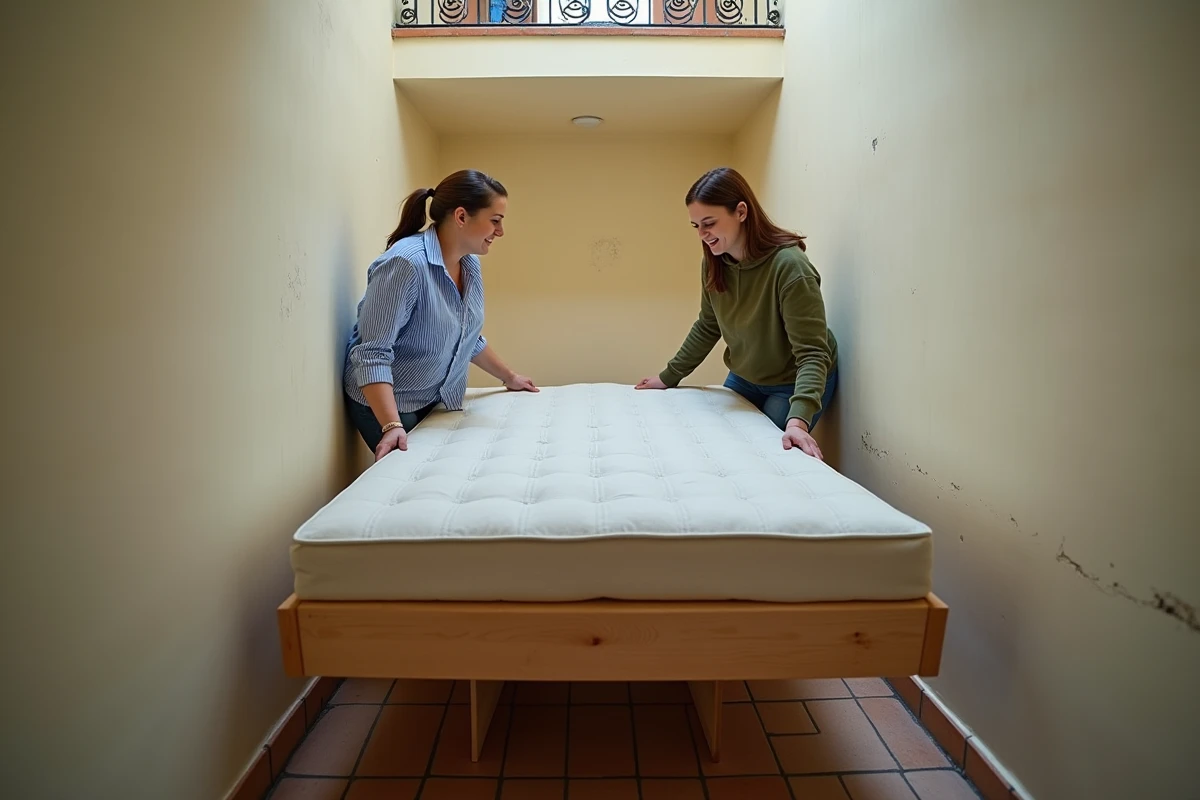
A box spring stuck in a stairwell, two people struggling to pivot the box spring without scratching the wall: the scene repeats itself at every move. The problem rarely lies in the available strength. It comes from a poor choice of technique and a rushed preparation of the route. Moving a box spring effortlessly relies on a few precise gestures, one or two well-chosen accessories, and an analysis of the path before lifting anything.
Box spring or slatted base: the strategy makes all the difference
You don’t approach a monobloc upholstered box spring the same way you do a removable slatted frame. The distinction has direct consequences on the number of people needed, the tools to prepare, and the risk of breakage.
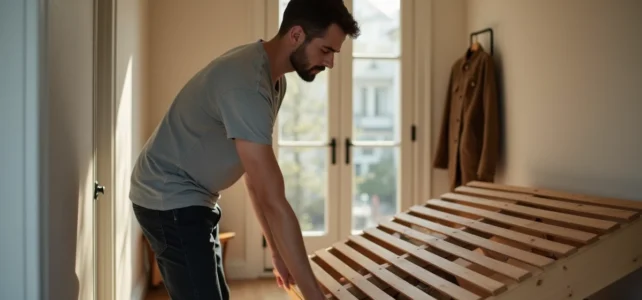
A removable slatted base separates into two half-frames once the legs are unscrewed. Each element becomes light and narrow enough to fit through a standard hallway without forcing. You remove the slats, group them with a tie or wide adhesive tape, and move everything in several short trips. For one person, this is the safest configuration.
The upholstered box spring forms a bulky rigid load. It cannot be folded or disassembled. Prevention recommendations (CARSAT, INRS) advise treating it as a single block, which requires a cart, straps, and prior marking of the path.
Some recent models, compliant with the NF EN 1725 standard, include reinforced side handles or factory grip points. Check for their presence before starting: they radically change the handling.
To delve deeper into the techniques for moving a box spring alone, the method differs depending on whether you carry or slide the load.
Moving sled and gliding pads: pull rather than carry a box spring
The most effective technique for moving a heavy box spring on flat ground is also the least mentioned in mainstream guides. Professional movers use it daily: place the box spring vertically on a moving sled (a low rolling platform, sometimes just a simple board mounted on wheels) and then pull it. One person is sufficient on flat ground, provided the thresholds are secured with a wedge.
This approach eliminates lifting. The weight rests on the wheels. You guide the box spring instead of lifting it. Field feedback published in industry blogs confirms its effectiveness, even for a double box spring.
Alternatives when you don’t have a sled
- Gliding pads made of felt or plastic are placed under the corners of the box spring laid flat. On parquet, tiles, or linoleum, they allow you to slide the load without scratching the floor. You push instead of carry.
- Two-person lifting straps, passed under the box spring, redistribute the weight onto the shoulders and thighs rather than the arms and back. They are particularly useful in staircases.
- A classic two-wheeled hand truck works for an upholstered box spring laid on its edge, but the width of the box spring must not exceed that of the hand truck. Feedback varies on this point depending on the available hand truck models.
In all cases, the basic rule remains the same: reduce pure carrying time to an absolute minimum and transfer the load to a rolling or sliding support as soon as possible.
Prepare the route before touching the box spring
Before unscrewing any legs, walk the path empty-handed. Measure the width of the doors, note the angle of the hallway, and check if the staircase turns. A standard box spring measures about 140 cm wide (for a double), which exceeds the width of most French interior doors. The passage is therefore on the edge, in a vertical position.
Three points to check before each move:
- Is the path completely clear (no shoes, no cardboard, no furniture that reduces the passage)?
- Do the door thresholds have a height that could block a cart or gliding pad?
- Is there a right-angle turn that requires tilting the box spring from vertical to horizontal along the way?
If a tight turn requires it, place the box spring on the ground, pivot it flat, then raise it. Forcing a passage at an angle can damage door frames and may twist the box spring frame itself.
Protecting the box spring and the home during transport
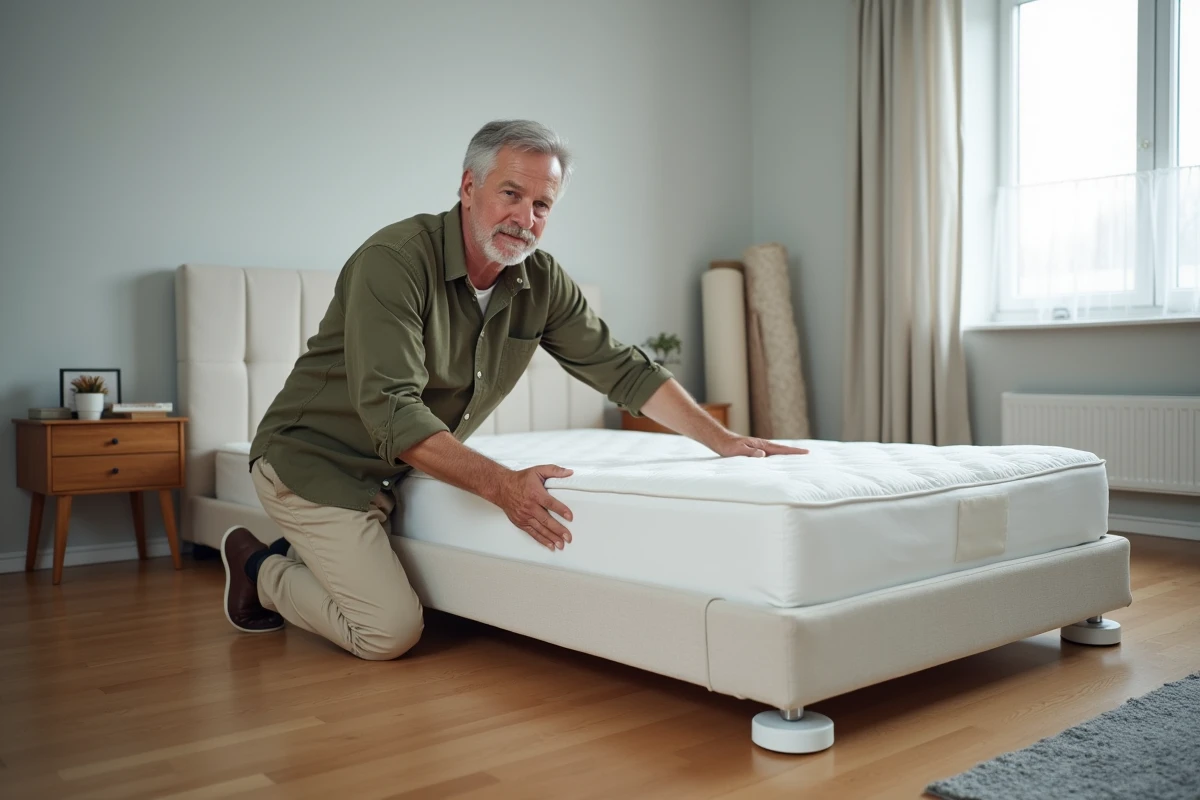
Wrapping the box spring in a protective cover or thick plastic film prevents scratches, dust, and moisture from reaching the fabric. For an upholstered box spring, this step also protects the walls: the textile covering the frame clings less to painted surfaces when covered with smooth film.
For loading into a vehicle (truck or van), the box spring is secured upright against the side wall, held in place by ratchet straps. Laid flat, it occupies the entire loading area and prevents stacking other furniture. On its edge, it leaves room for the mattress, bedding boxes, and the rest of the furniture.
Also protect the corners of the box spring with cardboard or foam corners, especially if the route includes a staircase or a narrow passage. Impacts to the corners are the leading cause of visible damage to an upholstered box spring after moving.
Moving a box spring does not require exceptional strength. It requires choosing the right technique based on the type of box spring, scouting the route in advance, and systematically favoring rolling or sliding over carrying. A slatted base can be disassembled and carried in pieces. A monobloc upholstered box spring is pulled on a sled or pushed on pads. The rest is corridor logistics.